Showing posts with label Wedding 101. Show all posts

Tuesday, February 2, 2010

EMILY SAYS… {The One About Money}

emily-post-1Why take my word for it when you could hear from the truest wedding expert of them all? Emily Post was the queen of etiquette, and weddings were and still are well recognized as a place to practice her rules.  Etiquette is often the backbone of every wedding tradition, and in the spirit of weddings, it wouldn’t be fair to ignore them here.
I wanted to start by relaying what she says about choosing a color scheme, but ironically enough, this is one of the few things she created structure for.  She simply says that this is a choice that can come from the season, the flowers, the formality of the occasion, or anything else.  So couples, have fun being creative, and don’t let anyone else stop you, since Emily sure won’t!
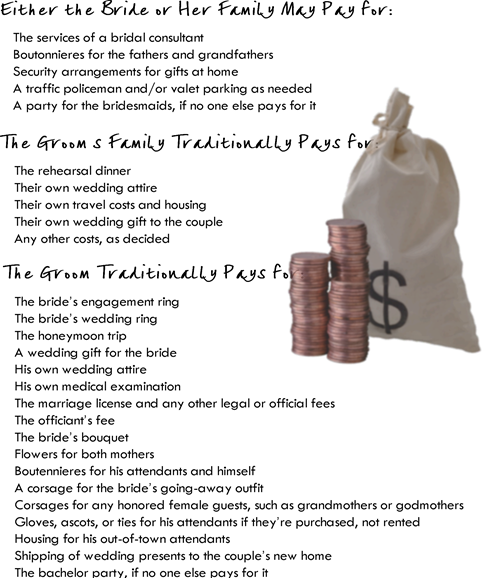
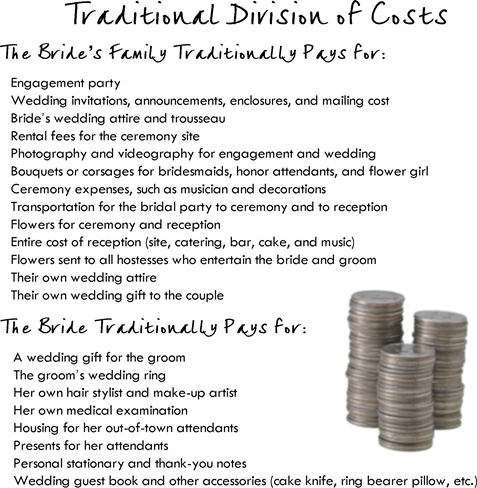
Instead I will talk about the ever popular topic of $$$$$.  Who traditionally pays for the wedding?  I once thought the answer was as simple as “the bride’s parents” too, but it’s not.  Here is a simplified version of Emily’s list.
CostChart1 CostChart2 CostChart3


My favorite part of this way of laying out the cost is the symbolism I see in what the groom pays for.  It reminds me of the phrase “chivalry isn’t dead.”  The groom traditionally pays for the vital parts of the wedding.  Not that the rest of the wedding isn’t important, but without what he pays for you’ve just got yourself a fancy party.  He covers the officiant fee, the marriage license, and just because he is a gentlemen, he pays for all the flowers for the brides and honored females.  He also pays for the honeymoon.  To me it is symbolic of a man taking on the role of supporting another person (not that the woman can’t do that as well).  It’s only a gesture, but it’s definitely a sweet one.
Even though this is what Emily says, it’s not set in stone.  The best way to determine who is paying for what is to sit down and have an honest conversation with everyone involved.  It is important to remember that no family member is required to pay for anything, and the bride and groom should wait for it to be offered. 
Now-a-days, the average cost of weddings is around $27,000 (which is a decline since the recession, as the average a few years ago was around $35K).  If you live in a major city you can expect that price to increase by about 20%. [these are not exact stats].  These weddings are based on the fact that most have a budget of up to 6 incomes (bride, groom, and if both sets of parents are divorced; 4 parental families).  That number may sound daunting, but I have heard it put an interesting way.  Your wedding begins your marriage, that lasts at least 50 years.  A $30,000 wedding day for a 50 year investment is only $1.64 per day.  {I am not saying I agree or disagree with that approach, I just wanted to pass it along :)}
If you’re putting that much into a wedding, I sure hope you’re investing in a good photographer and videographer in order to make sure the memories last forever!
SignatureChat2

Tuesday, December 8, 2009

WEDDINGS 101 {The One About Tulle & Taffeta}

I spent a lot of time thinking about a name for my blog, but once I decided on this name (I thought it had a nice ring to it), I realized I would probably need to explain it to a few people.  My father and boyfriend were, as expected, clueless as to what tulle and taffeta are.  As a wedding planner it’s embarrassing to admit that I too, didn’t know the names of the fabric either until not too long ago.
So I did some research, and am now quite educated on these fabrics, and I thought I would share a few snippets with you.
{TULLE: a thin netted, often stiffened, silk, nylon, or rayon fabric}

Tulle

{HISTORY} Tulle was invented in Britain in the 1800’s, and was popularized by the Parisian ballet (seen used as tutus).  The net fabric is named after the city Tulle in France.
{USES} This very durable fabric can be used in a variety of ways.  It’s most common use is in garments, particularly veils and wedding dresses.  (Personally, I just adore tulle skirts.)  They are also used for petticoats to help the dress skirt puff out.  Tulle is also a great decorative accessory as well, as bows, garlands, tent ceilings, or wrappings for favors.  This fabric is also well known for net canopies to keep bugs out.
There aren’t very many weddings you’ll go to where Tulle doesn’t attend as well.

……………………………………………………………………………………

{TAFFETA: a crisp, smooth, plain-woven fabric with a slight sheen.}

Taffeta

{HISTORY}  Taffeta, (formerly spelled taffety) is thought to have originated in Persia.  It’s name means “twisted woven.”  There are two types of textures; the soft piece-dyed taffeta that used in linings, and the more popular yarn-dyed taffeta which is stiff and sheen.  (I like to call it the loud fabric, because you can hear just about every movement in it.)
{USES} This fabric is often seen in the formal wear.  From the bride to the flower girl, and from the groom to the ring bearer, someone is most likely wearing this fabric.  Because of it’s stiff nature, the designs can be very creative and add a variety of textures to a garment.  Taffeta is also seen as linens, curtains, bows, ribbons, and (having nothing to do with weddings whatsoever) is sometimes used for electrical insulation.  A very handy fabric indeed.

SignatureChat2